April 23, 2025 · 8 min read
Identifying Common Tree Diseases in North Alabama
Six diseases that are actively killing trees across the Tennessee Valley — and what to look for on your own property.
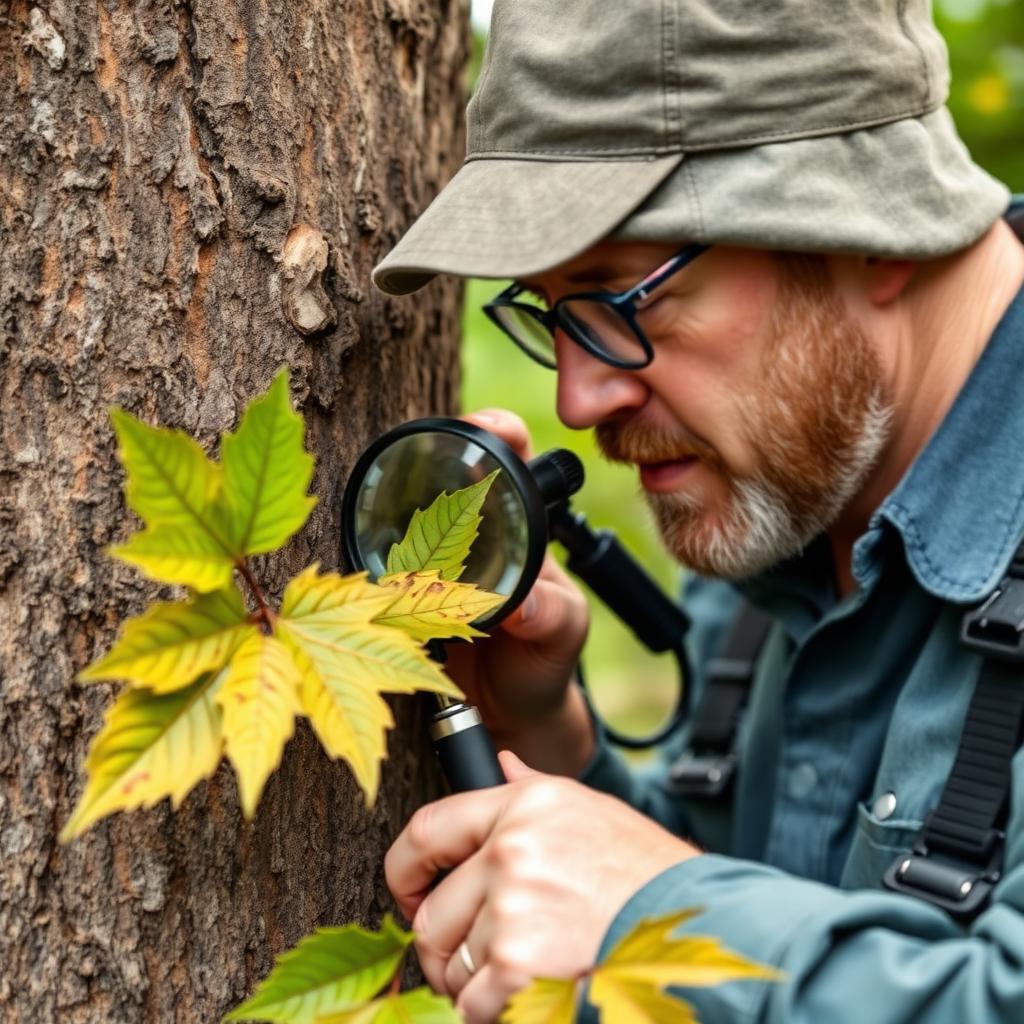
North Alabama's warm humid summers, mild winters, and dense tree canopy create perfect conditions for a long list of tree diseases. Most homeowners only call an arborist after a tree is dead, when there's nothing to do but remove it. Catching disease early — when there are still treatment options — requires knowing what to look for. Here are the six most common and most destructive diseases we see in the Tennessee Valley.
Hypoxylon canker is probably the single biggest killer of mature oaks in our area. It's a fungal disease that attacks trees already weakened by drought, construction damage, or root compaction. The telltale sign is bark that sloughs off in sheets, revealing a silvery-grey or olive fungal mat underneath that eventually turns dark brown or black. Once you see the fungus on the bark, the tree's wood is already extensively decayed — there is no effective treatment. Removal becomes urgent because hypoxylon-infected trees become structurally unsound quickly.
Bacterial leaf scorch (BLS) is increasingly common on red oaks, pin oaks, and sycamores in Huntsville. It causes leaves to brown along the margins starting in mid to late summer, with a distinct yellow band between the dead tissue and the healthy green interior. The browning starts on older leaves and progresses outward over multiple seasons. There is no cure, but injected antibiotics can slow progression and add years to the tree's life when started early.
Oak wilt is less common in our area than in Texas or the Midwest but has been confirmed in North Alabama. It moves through root grafts between trees of the same species and through beetles carrying the spores. Red oak group species (water oak, pin oak, red oak) wilt and die in a single season; white oak group species decline over several years. Symptoms include rapid leaf wilting from the top down, water-soaked-looking leaf veins, and pressure pads forming under the bark. Treatment with propiconazole injections can protect adjacent healthy trees but cannot save symptomatic ones.
Emerald ash borer (EAB) has been confirmed in Madison County. This invasive beetle's larvae tunnel under the bark of all native ash species, cutting off the tree's circulation. Symptoms include thinning canopy starting at the top, D-shaped exit holes in the bark, S-shaped galleries when bark is peeled, and aggressive epicormic sprouting along the trunk. Once a tree is more than 30% canopy decline, treatment is rarely successful. Healthy ash trees can be protected indefinitely with emamectin benzoate trunk injections every two to three years.
Pine bark beetles — primarily southern pine beetle and Ips engraver — kill loblolly and shortleaf pines across our region every year, especially during drought. The first sign is usually yellow or rust-colored needles in the upper canopy, often with pitch tubes (popcorn-like resin masses) on the bark. By the time you see symptoms, the tree is usually too far gone to save. Adjacent healthy pines can be protected with carbaryl bark sprays during active infestations, but rapid removal of infested trees is the most important step to prevent spread.
Anthracnose appears on dogwoods, sycamores, oaks, and several other species during wet springs. On dogwoods specifically, dogwood anthracnose (Discula destructiva) can be fatal in shaded, humid sites — it causes leaf spots that progress to twig dieback and ultimately trunk cankers. Treatment includes pruning out infected wood, improving air circulation, fungicidal sprays during leaf-out, and selective replacement with kousa dogwood or other resistant species in problem locations.
Powdery mildew is the white-gray dusty coating you see on dogwood, lilac, and crepe myrtle leaves in late summer. It's almost never fatal but is unsightly and can weaken the tree if severe. Most cases resolve themselves with weather change; persistent cases respond to fungicide and to pruning that improves air circulation through the canopy.
Beyond identifiable diseases, watch for general stress signs: thinning canopy, premature fall color, undersized leaves, sparse new growth, bark cracks not caused by impact, and excessive seed or cone production (a stress response called 'death blooming'). These don't always indicate disease, but they signal a tree under stress and worth professional evaluation.
Honest disclosure: no responsible arborist can diagnose disease from a phone description. Many of these conditions look similar in early stages, and accurate diagnosis often requires close inspection, sometimes tissue or soil samples. Anyone who quotes you a treatment plan over the phone without an inspection is selling you something you may not need.
If you suspect disease in any tree on your property, get an ISA-certified arborist out for a real diagnosis. Huntsville Elite Tree Service provides honest assessments, written treatment plans (or honest 'this tree can't be saved' recommendations), and itemized pricing. Call us at (256) 555-0184 to schedule.