July 2, 2025 · 6 min read
Cabling and Bracing: Saving Hazardous Trees
When a tree has serious structural defects but enormous landscape value, the right hardware can buy decades of additional safe life.
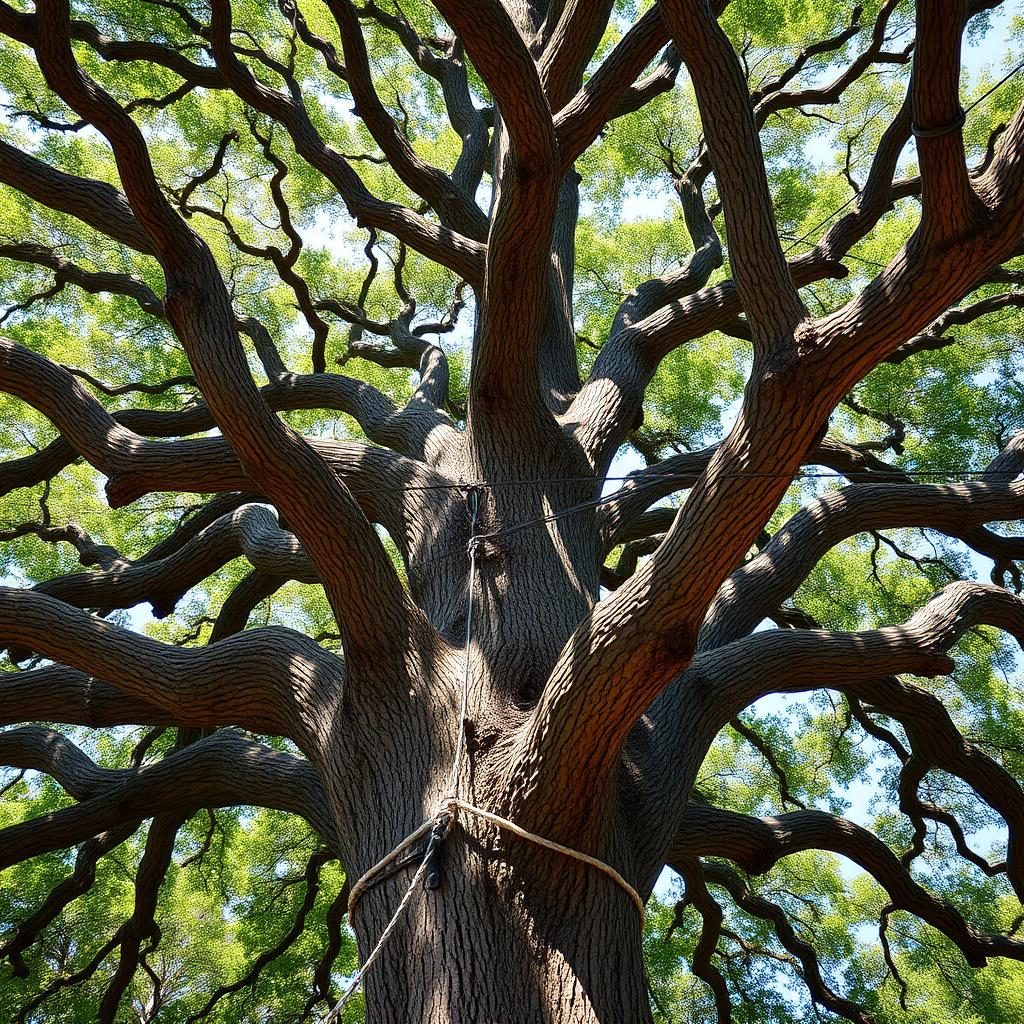
Some trees are too valuable to lose but too defective to leave alone. A century-old white oak with a co-dominant trunk split, a massive shade tree with a long horizontal limb at risk of failure, a heritage magnolia at the center of a front yard — these are the trees where the right answer is neither removal nor hoping for the best. The right answer is cabling and bracing.
Cabling is the installation of high-strength steel cables between major limbs or stems, set high in the tree, to redistribute storm loads and prevent catastrophic splitting. Bracing is the installation of threaded steel rods through unions to bolt parts of a tree together at the structural defect itself. Both techniques have been in use for over a century and, when properly installed, can add decades of safe life to a structurally compromised tree.
The most common reason for cabling is co-dominant stems with included bark. When a tree forms two co-dominant trunks (a 'V' shape) instead of one dominant trunk with side branches, the union often traps bark inside the joint. Over decades, the trunks grow larger, the included bark forms a weak seam, and at some point the union splits — usually catastrophically, often in a storm, almost always taking out half the canopy and creating a major hazard.
A cable installed about two-thirds up the tree, connecting the two stems, redistributes wind loads and dramatically reduces the chance of split. We use 7x19 stainless steel aircraft cable rated for several thousand pounds tensile strength, anchored with thimbles and either eye bolts (extra-high-load system) or lag-eye screws (standard residential system) installed into solid wood.
Bracing addresses an existing crack or split. If a tree has already partially failed at a union, a bracing rod threaded through both sides of the union and bolted in compression can hold the wood together, allow the cambium to grow back over the wound (slowly), and let the tree continue functioning. Bracing is usually combined with cabling above the rod for full structural redundancy.
When cabling and bracing are the right choice: large, healthy, valuable trees with a single identifiable structural defect (typically co-dominant stems or a heavy lateral limb at risk of failure), trees where removal would be a major landscape loss, and trees where the cost of cabling ($300 to $1,500 typically) is small compared to the cost of removal plus replanting.
When cabling and bracing are not the right choice: small or young trees (almost always cheaper to remove and replant), trees with widespread structural problems (cabling one defect just shifts the failure to the next weakest point), trees with extensive trunk decay (no sound wood to anchor hardware into), and trees in low-target locations where natural failure wouldn't hit anything valuable.
Installation requires a real climber with structural training. Improperly installed cables can actually accelerate failure — placed too low, sized wrong, or anchored into compromised wood. We use ANSI A300 part 3 standards for all cable and brace installations and document each installation with photos and a written record.
Maintenance is part of the deal. Cables should be inspected every two to three years, looking for hardware fatigue, growth issues at anchor points, and any new structural problems elsewhere in the tree. Most properly installed cables last 15 to 25 years before requiring re-tensioning or replacement.
One myth to bust: cables and braces do not weaken the tree. Trees grow strong wood around hardware over time, and modern installations use materials and techniques that have decades of proven performance. The 'cables hurt trees' folklore comes from old practices (chain wrapped around the trunk, etc.) that are no longer used.
If you have a tree on your Huntsville-area property with visible structural concerns — a split union, a heavy leaning limb, an obvious crack — get an arborist out before you commit to either removal or 'hoping.' Cabling might give you another 30 years with a tree you'd otherwise lose. Call Huntsville Elite Tree Service at (256) 555-0184 to schedule a structural assessment.